
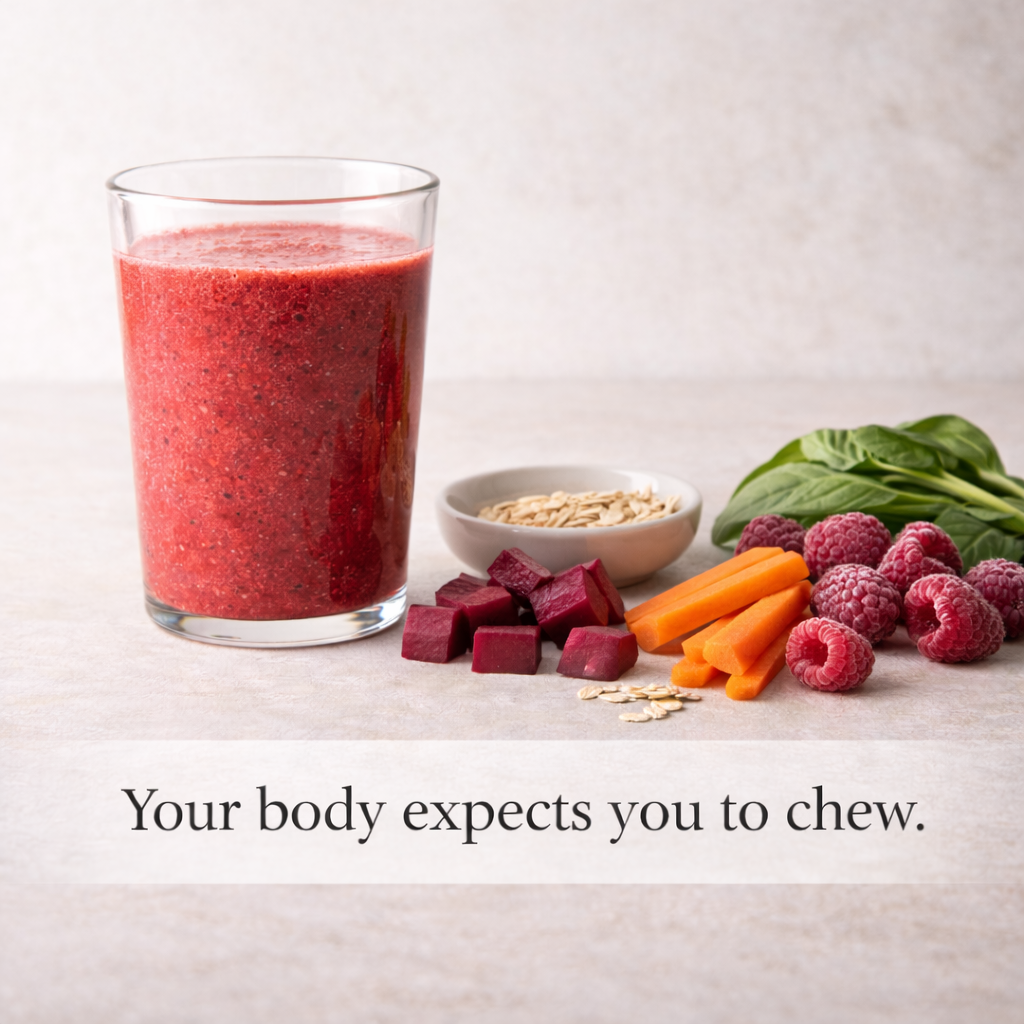
What Happens When Blending Replaces Eating
Smoothies aren’t harmful by default.
But overuse and misuse come with real consequences - and pretending otherwise doesn’t help anyone.
Chewing matters more than people realize
Chewing isn’t optional biology.
It’s the first step of digestion.
When you chew:
- Saliva releases digestive enzymes
- Signals are sent to the stomach and pancreas
- The body prepares for nutrient absorption
- Satiety hormones are activated
Liquids skip most of this process.
When smoothies replace meals regularly, the digestive system loses an important cue system. This can affect:
- Hunger regulation
- Fullness signals
- Blood sugar control
- Digestive efficiency
Liquid calories change how the body responds
Liquids move through the digestive system faster than solids.
That means:
- Less satiety
- Faster glucose absorption
- Easier overconsumption
- Shorter-lasting fullness
This is why many people feel hungry again soon after a smoothie - not because smoothies are “bad,” but because liquids don’t trigger the same physiological responses as solid food.
Teeth and oral health take a hit
Smoothies are often:
- Acidic (fruit, citrus)
- Sipped slowly
- Consumed frequently
This combination increases:
- Enamel erosion
- Tooth sensitivity
- Cavity risk
Chewing solid food stimulates saliva flow, which protects teeth. Smoothies don’t provide that same protection.
The laziness problem (yes, it’s real)
Smoothies are often sold as “simplifying nutrition.”
But for many people, they become:
- A way to avoid eating
- A way to avoid planning meals
- A way to avoid appetite cues
This isn’t discipline. It’s avoidance.
When smoothies are used to replace meals out of convenience rather than need, nutrition quality often drops - not improves.
When smoothies are medically appropriate
There are legitimate reasons to rely more heavily on smoothies:
- Medical recovery
- Dental issues
- Severe digestive disorders
- Temporary appetite loss
- Specific clinical nutrition plans
Outside of those contexts, turning smoothies into a lifestyle is rarely beneficial long-term.